If you would like to know more about the brand new state-of-the-art seismic retrofit guideline, there are around 30 educational videos and web pages that you will find interesting. Just type ICC 1300 in the search box in the upper right.
Staples Are a Viable Alternative to Nails
Here are two videos related to stapled connections, both plywood sheathing, and framing. There is no other fastener that can replace the staple in seismic retrofit work. Here I am making the case that staples are a viable, and sometimes necessary, alternative to nails and their omission from all the seismic retrofit standards, including the newest ICC 1300 standard Vulnerability Based Seismic Assessment and Retrofit of One and Two-Story Dwellings is a serious error. Staples have not only had extensive testing over the years but are already part of the building code. In this video I will be showing you why stapled shear walls are often the best choice.
I put the essentials of my argument in the text and graphics below, though I think the videos are much more informative.
This 2-minute video looks at a technician using both 1 1/2′ staples and 2 1/2″ to create a very high-strength shear wall. If you want to see all the engineering documentation and this video together in one place, watch the other video.
This 20-minute video looks at all the testing and code citations that justify staple use.
This 40-minute video gets into the nitty-gritty.
What Does the Building Code Say About Staples in Seismic Retrofit Work?
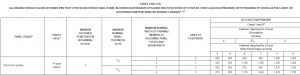
This TABLE from the California Building Code assigns a shear wall with 3x edge framing a 1200plf capacity if two rows of staples are used. In the field, it is easy to create 3x equivalent framing by sistering two 2xs together as recommended by this technical note by the American Plywood Association. The technical note makes using staples in seismic retrofit work a viable option. These shear walls are stronger than the strongest shear walls in ICC 1300.

This is a summary of what was discovered when the tests were done that created this table. We have confirmed this in the field many times and have found staples can be as close as 1/2″ apart slightly staggered with no ill effects.
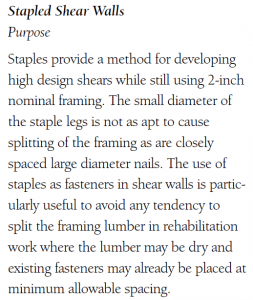
This is a confirmation of one of the testing labs’ other test discoveries. This particular citation comes from the study of stapled shear walls in APA Research Report 154. We have not found splitting to be an issue with dry lumber but have on many occasions found over penetrated nails in shear walls that required staples using the guidance in this report from the American Plywood Association. This is an ideal use of staples in seismic retrofit work.
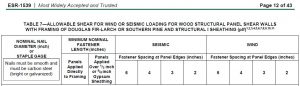
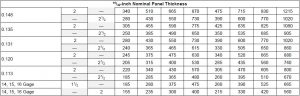
This table is from ESR 1539 and as you can see, stapled shear walls with nominal 2x framing are rated for a shear capacity of 665plf.

This is from Table 2304.10.1 FASTENING SCHEDULE in the California Building Code. Practically every connection in this table contains both a nail and a staple option. This confirms that staples are a good option in lumber fastening.
In summary, there is no reason why staples should not be considered a viable option in seismic retrofit work and any guidelines subsequent to ICC 1300-Standard: Vulnerability-Based Seismic Assessment and Retrofit of One and Two-Family Dwellings
T


