This video was created to explain the principles and practices behind the Bay Area’s Regional seismic retrofit Guideline Standard Plan A.
Standard Plan A: A Second Look.
Standard Plan A was published in 2006 and revised in 2008. The owner of Bay Area Retrofit and author of this article Howard Cook was on the original 2006 committee but was not on the 2008 revision committee.
It is based on these calculations made by Jim Russel P.E. in 2004. Since its publication it has been widely used by the California Earthquake Authority Earthquake Brace and Bolt grant program as well as by all the building departments in the San Francisco Bay Area. Based on this wide scale acceptance it will certainly be used for many years to come. The purpose of this article is to look at this 20 year old guideline and see if it needs to be modernized in light of current hardware types and retrofit strategies.
Standard Plan A Retrofits Are Only Half As Strong As They Were Intended To Be
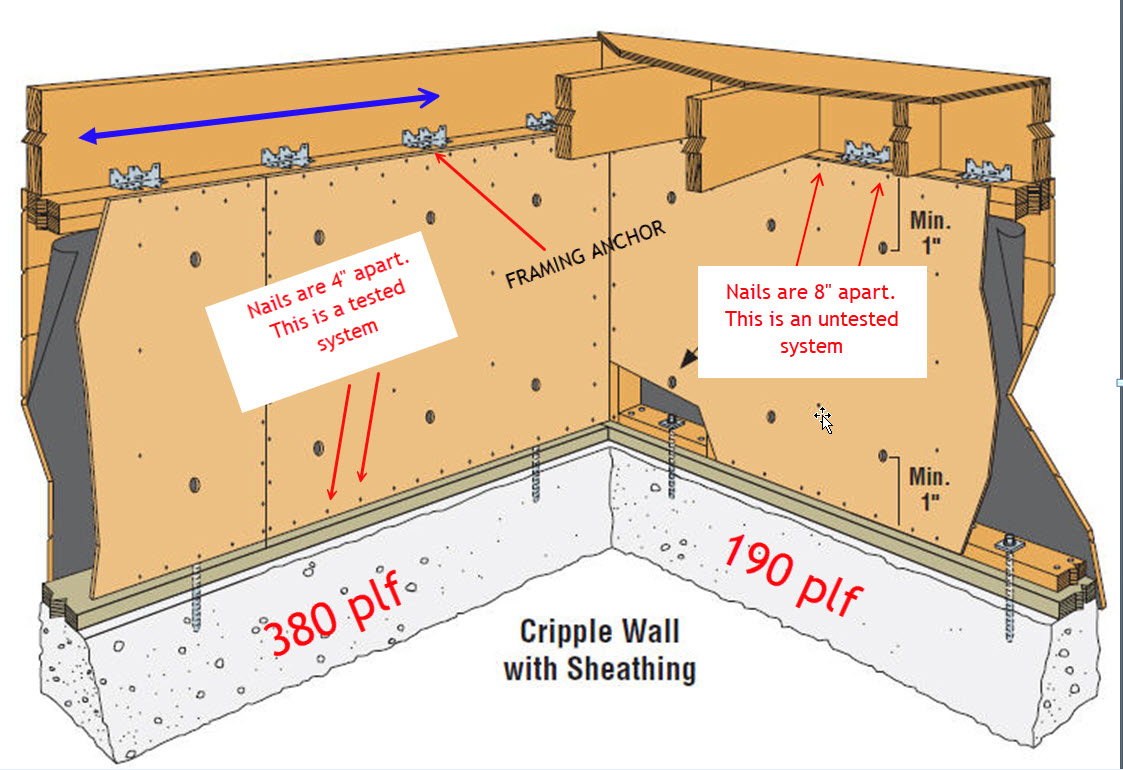
Standard Plan braces vulnerable cripple walls with plywood. Plywood’s earthquake resistance depends in large part on the spacing of the nails on the plywood edges. The original 2006 committee that I was on spaced the edge nails 4″ apart. When it was revised in 2008 this was changed to 8″ apart which reduced the earthquake resistance of the plywood by 50% from 380 pounds of earthquake resistance per linear foot to 190. The retrofits were now only half as strong as they were intended to be. In addition, the earthquake resistance of plywood with edge nails 8″ apart has never been tested and is not recognized by the building code.

CONSTRUCTION DETAIL FROM STANDARD PLAN A- INCORRECT NAILING.

STANDARD PLAN A PLYWOOD NAILING PATTERN
These two images are from Standard Plan A. The blue arrow on the left figure points to the lower top plate which is NOT where the plywood is supposed to be nailed. The green arrow points to the upper top plate which IS the edge where the edge nailing should be. The red arrows point at the misplaced, purely decorative, nails in the lower top plate.
The figure on the right shows where Standard Plan A’s requires nails in both the upper and lower top plates. The result is 8″ apart edge nailing in the upper top plate which again, has never been tested.
This is what happens in an earthquake: When the floor slides as shown by the blue arrow that movement goes into the framing anchors. The nails in the framing anchors are 1 1/2 inches long which means they are only attached to the upper top plate. So when the framing anchors slide that motion goes into the 8″-apart-nails in the upper top plate. That motion then goes through the nails, into the plywood, and finally into the bolts and foundation.
The original 2006 edition of Standard Plan A specified nails 4″ apart in the upper top plate alone which created plywood bracing that could resist 380 lbs. of earthquake force per linear foot. In 2008 when the nail spacing was reduced to 8″ apart, this resistance was cut in half such that it can now only resist 190 lbs. per linear foot. Actually, no one knows if plywood nailed 8″ apart will do anything at all. It has never been tested.
I asked Dr. James Dolan, a well-renowned expert in shear walls for his opinion. This is what he had to say.
“Hi Howard
Well, first, if the top plate is stitched together to transfer the forces between the two and act as a pair and not individual members, the effective shear wall nailing schedule would be 4-in o.c., which the SDPWS give a 700 plf LRFD (350 plf ASD) design value to. If the top plate is not stitched together properly then the capacity would be lower. The blocking at the bottom would help stiffen the wall a bit, but since all of the blocks do not seem to be bolted to the foundation, the additional nailing to them would not increase the lateral capacity that much. It is a bit complicated, and since I have not directly tested or read of any tests with similar configurations, I would not count on them much. If Ben Schmidt or John Kariotis (SEAOSC) tested this configuration, I have not seen the results. The bottom of the sheathing does not seem to be attached to the continuous mud sill very well.
Sorry that I cannot be of more assistance.
Dan”
Dr. J. Daniel Dolan, P.E.
Professor Emeritus
Department of Civil and Environmental Engineering
Composite Materials and Engineering Center
Washington State University
P.O. Box 645815
Pullman, WA 99164-5815
How Much Money Has Been Spent On Standard Plan A Retrofits?
The California Earthquake Authority EBB program has as of January 2025 provided $3,000 grants for approximately 10,000 Standard Plan A retrofits for a total of $30,000,000 dollars in taxpayer money. The program is in still in effect and many more Standard Plan A retrofits will be paid for in the future.
$3,000 pays for approximately 1/3 of the average CEA retrofit so homeowners have contributed another $60,000,000 for a total of $90,000,000. The Cities of Berkeley and El Cerrito also require its use in their residential retrofit subsidy programs. These Cities and their citizens have probably spent another $10,000,000 on Standard Plan A retrofits. Standard Plan A retrofits done by homeowners independent of these programs will also account for untold millions of dollars. In short, approximately $110,000,000 has been, and will continue to be, spent on Standard Plan A retrofits. This is why it needs to be based on sound engineering and a strong consideration of cost.
How Is Earthquake Force Measured?
Just imagine a man weighing 300 lbs. suddenly jumps on a bathroom scale. The speed of his body as it falls on the scale is its velocity. Velocity is defined as the change in position divided by the time of travel. Terms like miles per hour are a measure of velocity. The velocity x 300 lbs. is the amount of vertical force that will be hitting the top of the scale measured in pounds of force. When this same force is directed sideways you have a lateral force also measured in pounds of force. This is how earthquake forces are measured.
Earthquake resisting hardware is measured by its capacity to resist lateral earthquake forces. Imagine a piece of hardware nailed to a to a 2 x 4. If a lateral force of 300 lbs. is applied to the hardware and it bends or the nails pull out of the 2 x 4 we say this hardware has failed and has a capacity of 300 lbs. If the nails are the first to fail, we say the nails are the failure mode. If the hardware bends first, the hardware is the failure mode.
Plywood is rated in terms of its ability to resist lateral earthquake forces per linear foot. Plywood in Standard Plan A is supposed to resist 380 pounds per linear foot. For example, if a cripple wall is braced with 10 linear feet of plywood it means it can resist 3800 pounds of force before the plywood will fail, usually when the nails pull through.

The REINFORCEMENT SCHEDULE
The REINFORCEMENT SCHEDULE is the bedrock of every Standard Plan A retrofit. Let me try and explain how it works.
In this sample case the REINFORCEMENT SCHEDULE tells us a 1200 square foot 1-story light construction house requires a minimum of 14’8″ of plywood bracing, (7) 1/2″ bolts, and (13) L70s on each wall line in order to meet Standard Plan A’s cripple wall retrofit requirements.
Light construction means the exterior walls are wood with drywall on the interior walls.
Remember, the REINFORCEMENT TABLE is based on plywood nailed in such a way that it can resist 380 Lbs. per linear feet which is only achieved if the nails are 4″ apart in the upper top plate, not the 190lbs provided by 8″ o.c. top plate nailing required by Standard Plan A. If we use the actual 190 lbs. per linear foot we must double the linear footage of plywood to 29′ 4″ which increase the cost of the retrofit considerably.

The Standard Plan A CONNECTOR CAPACITY TABLE

The CONNECTOR CAPACITY table above is in Standard Plan A and shows the earthquake-resisting capacities of various types of hardware according to Standard Plan A. These capacities inform the REINFORCEMENT SCHEDULE and if they are incorrect the REINFORCEMENT TABLE will not be accurate. The numbers on the left represent the earthquake resisting capacity of the hardware while on the right it tells us the name of the hardware, in this case the Simpson L70. We are told the L70 has a capacity of 458 lbs. and on the right column we are told it must be installed with eight (8)-10d nails x 1 1/2″ long. 10d means the nail is 0.148″ in diameter.
Below you can see the Standard Plan A CONNECTOR CAPACITY table compared to the table on the right that meets the 2025 building code. As you can see, every capacity listed in Standard Plan A’s table is wrong.

CONNECTOR CAPACITIES IN STANARD PLAN A

CONNECTOR CAPACITIES PER CODE
Why Is The CONNCTOR CAPACITY Table Important?
The CONNECTOR CAPACITY Table has a direct correlation to the retrofit designs found in the REINFORCEMENT SCHEDULE. The best way to explain this is by looking at the sample design we created earlier.
Standard Plan A’s engineering calculations tell us this house will be subjected to 3,794 lbs. of lateral force on each wall line. Standard Plan A’s plywood has a capacity of 380 plf (pounds of resistance per linear foot). If we install 14’8″ of plywood as shown on the REINFORCEMENT SCHEDULE, the plywood has the capacity to resist 5,570 lbs. of earthquake force on each wall line.
On the other hand, the building code tells us Structural 1 plywood nailed 2″ apart on the edges can resist 730 lbs. per linear foot. If we use this plywood and follow the SCHEDULE, the plywood will resist 10,220 lbs. of earthquake force on all sides.
If we nail the upper top plate 8 inches apart in the upper top plate we will gain a capacity of 2,660 lbs. of resistance on each side.

Likewise, a 1/2″ bolt has a capacity of 820 lbs. such that the 7 bolts bolts shown in the bolt column have an earthquake-resisting capacity of 5,740 lbs.
Finally, the L70 framing anchor has a capacity of 458 lbs. If we install 13 of these as required by the REINFORCEMENT SCHEDULE the earthquake resisting capacity equals 5,940 lbs. Each earthquake resisting component; plywood, bots, and framing anchors can resist approximately 2,000 lbs. more than the 3,794 lbs. of force the calculations told us this house must resist. This house can therefore be considered fully retrofitted.
Notice how the 5,570 lbs. of plywood lbs., the 5,740 lbs. of bolt capacity , and the 5,940 lbs. of framing clip capacities are almost equal. This balance is the hallmark of a cost-effective retrofit because any capacity that exceeds the weakest capacity of any component is redundant and wasteful. FEMA P-1100 on the other hand is an example of a retrofit standard that is very wasteful and out of balance.
The problem with all of this is the fact that all the capacities listed in the CONNECTOR CAPACITY table are wrong and therefore the REINFORCEMENT SCHEDULE is inaccurate.
The Actual Capacity of the L70
Table 2 below shows the actual capacity of the Simpson StrongTie L70 from an ICC Evaluation Report. Notice it has a capacity of 740 lbs., not the 458 lbs. shown in the CONNECTOR CAPACITY table. This is nearly a 40% difference.
TABLE 2

Let’s assume the REINFORCEMENT SCHEDULE requires (20) L70s with a capacity of 458 lbs. on each wall line for a total capacity of 9,680 lbs. If the house has 4 sides we need a total of 80 L70s for a cost of $4,000 if the installed price of an L70 is $50 each.
If we use the 740 lbs. capacity found in the ICC report just (14)-L70s provide us with 10,360 lbs. of capacity on each wall line which is more than the 9,680 we need. If the house has 4 sides we need a total of 56 L70s are required for a cost of $2,800. In other words, if ones uses the actual capacity of the L70 rather than the inaccurate capacity found in the CONNECTOR CAPACITY table you get more earthquake resistance with less hardware with a cost savings of $1,200.
The Simpson Strong-Tie L90
The same is true with the Simpson L90. In the CONNECTOR CAPACITY table a L90 can has a capacity of 600 lbs. TABLE 2 from the Simpson Catalog gives us the actual capacity of 925 lbs. This is a 35% difference. Use of the 600 lb. capacity found in the CONNECTOR CAPACITY Table instead of its actual 925 lb. capacity results in waste similar to that found when using the Simpson L70.
TABLE 2

PAGE FROM THE SIMPSON STRONGTIE CATALOG SHOWING THE CAPACITIES OF THE SIMPSON L70 AND L90
Consequences
Standard Plan A is more expensive than it needs to be because the CONNECTOR CAPACITY table has inaccurate capacities. Using accurate capacities will reduce the cost and at the same time provide for an equal, if not greater, quality retrofit.

The H10 Anchor

THE CAPACITY AND NAILING OF THE H10 HARDWARE
The CONNECTOR CAPACITY Table contains a 505 lbs. capacity for an H10 framing anchor. H10 framing anchors are no longer made and have been replaced by the 565 lb. H10A hardware for post ~1950 construction and the 490 lbs. capacity H10AR hardware for pre ~1950 construction. Pre ~1950 homes always use the H10AR because it fits full sized framing that is 2″ thick compared to the H10A which fits modern lumber that is only 1 1/2″ thick. The 505 lb. H10 capacity in the CONNECTOR CAPACITY Table does not equal the capacity of the H10A or the H10AR hardware and is inaccurate under all circumstances. This is one more error in Standard Plan A’s CONNECTOR CAPACITY table which can reduce effectiveness and increase cost.
Using The Wrong Nails
The CONNECTOR CAPACITY table tells us the H10 hardware needs eight (8) – 0.131 (diameter) x 1 ½ (long) nails. Neither the H10A nor H10AR hardware uses this size nail. Instead, they use (9) .148 x 1 1/2″ nails at the bottom and (9) nails on the side for a total of EIGHTEEN nails, as shown in the green and red boxes from the Simpson Strong-Tie Catalog below. This is contrary to the EIGHT nails shown in the CONNECTOR CAPACITY table. When hardware uses less than half the required nails in addition to the incorrect sized nails, the manufacturer rates the hardware at zero capacity.


PHOTOGRAPH OF AN H10AR
Standard Plan A Bolting Hardware
The CONNECTOR CAPACITY table rates the earthquake resisting capacity of a 1/2″ bolt at 820 lbs. According to the American Wood Council connector calculator the actual capacity is 1038 lbs..
Similarly, the CONNECTOR CAPACITY Table rates the capacity of a 5/8 bolt at 1170 lbs., while the actual capacity is 1484 lbs.
For example, let’s say the REINFORCEMENT SCHEDULE requires (10) bolt for a capacity of 14,840 lbs. on each wall line for a total of 40 bolts if the house has 4 sides. If we use the old inaccurate 5/8″ bolt capacity of 1170 lb., we will need 13 bolts (14,840/1170 = 12.6 bolts rounded up to 13) on each wall line for a total of 52 bolts. If we use the actual bolt capacity of 1,484 lbs., we only need 10 bolts on each wall, for a total of 40 bolts. If bolts cost $100 each we save $1200 on this retrofit if we use the correct bolt capacity.
The Substitution of the UFP10 With The URFP
The CONNECTOR CAPACITY table uses a low clearance bolting hardware called the UFP10 with a capacity of 1340 lbs. The Simpson UFP10 is no longer available. Instead contractors use, and building departments accept, the Simpson URFP which has a higher capacity of 1530lbs. This is a capacity difference of 13%. The cost of retrofits that use the URFP can be reduced by 13% if the correct capacity is used. The labor and material cost for each product is the same.

The Mudsill Connection
The Problem

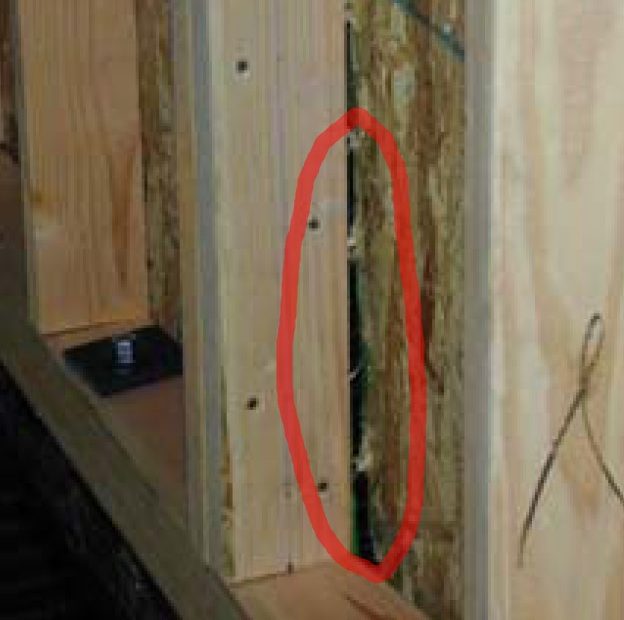
There are four ways to modify the framing so the plywood is attached to the mudsill

One of the reasons this method is used is because the plywood can now be nailed into old growth redwood that is many times less prone to splitting than wood grown on tree farms.


.

NAILING REVERSE BLOCK SHEAR WALL ONTO MUDSILL.

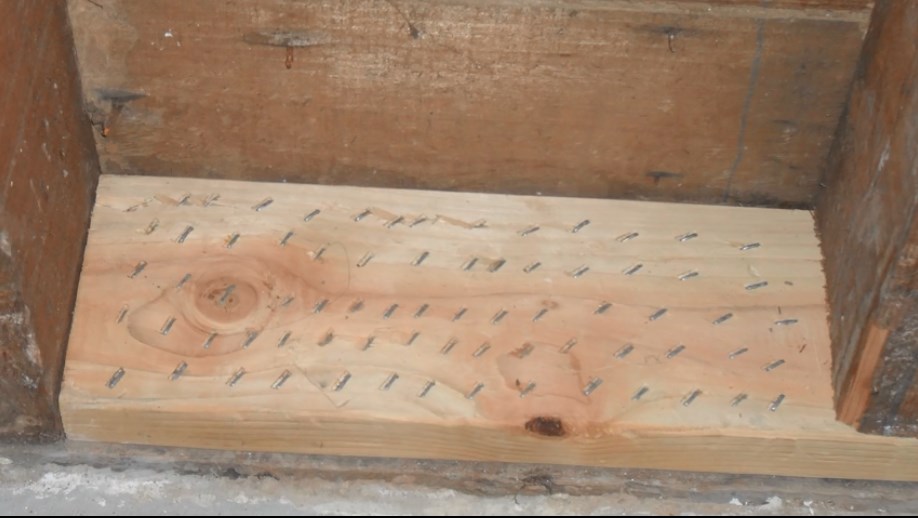
STAPLED BLOCK WITH STRENGTH OF 50 NAILS AND NO SPLITTING.
The Nailed Blocking Method

On the left, 2 by 4 blocks have been nailed onto the mudsill. On the right, the plywood has been nailed to the blocks.

TECHNICIAN NAILING A BLOCK ONTO THE MUDSILL
Standard Plan A uses the Nailed Blocking Method

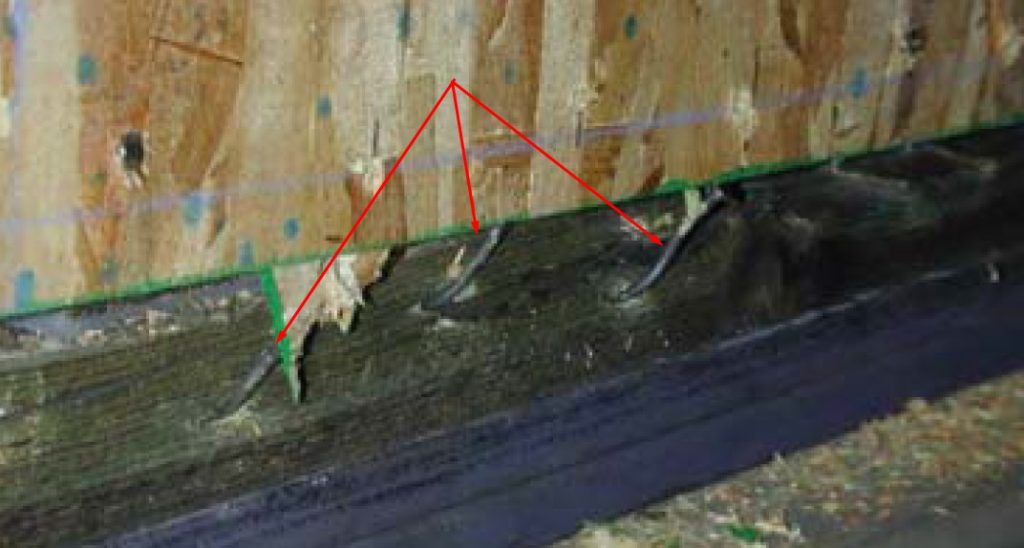
The Problem With Nailed Blocks Is That They Split

The senior engineer at the America Plywood Association evaluated all these methods and came to the following conclusion:


