It is possible to do a complete retrofit “by the book” and leave the house unprotected. All extant seismic retrofit guidelines fail to consider the importance of room additions . Find out why this is a problem.
Room Additions: A Hidden Danger
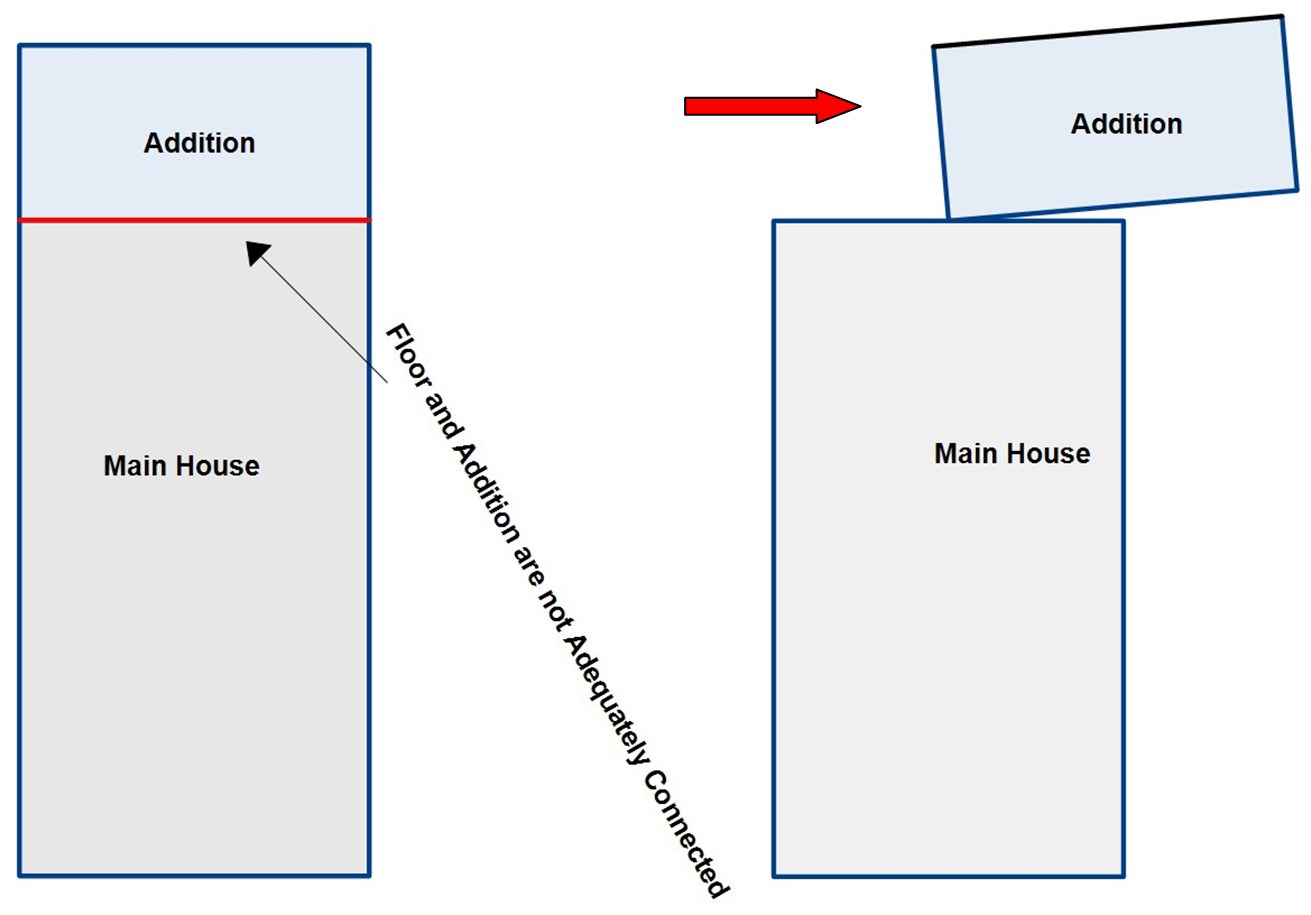
You might retrofit your house by precisely following the various retrofit guidelines and your house will be just as exposed to damage as it was before you did anything at all. Many people do not understand that if the addition is not connected to the house, the addition can fall off. This webpage will help you make sure this does not happen to you.
It is not uncommon for an older home to have originally been 900- 1200 square feet. Over time demand for larger homes increased considerably. Many homeowners built additions on the back of their houses (such as the 1955 house I live in).
The building code does not tell a contractor how to connect an addition to the main house and contractors are not thinking of earthquakes when they build an addition. In most cases a contractor will put in enough nails to make sure the addition does not fall down after he jumps on it a few times and no consideration is given to future earthquake damage. We have seen this many times.
Existing Cripple Wall Bracing Is Often Missing
If the houses have wood siding, contractors often completely remove the wood siding from the rear main house cripple wall at the addition location. This siding is the cripple wall bracing and once it is removed this cripple wall has no protection. The upright 2 x 4 studs stay in place.
Because stucco is so much harder to remove, contractors usually break out the top 12 inches of stucco to access the main house floor framing. However, the effect is the same, the floor connection to the stucco cripple wall bracing is broken.
This unbraced wall will need to protect the back of the main house and the front of the rear addition. When the contractor removed the siding or stucco on the back of the main house he doomed both the main house and the addition
You could easily do a retrofit on the perimeter (front, sides, and back of the addition) as prescribed by FEMA P-1100, Appendix Chapter A3, or Standard Plan A on a house like this and accomplish nothing because the most serious weakness would have been overlooked. If you have an addition, make sure your proposal mentions this and find out how the contractor is going to deal with it.
What To Do About It
Sometimes the addition is attached to the floor in such a way that you can’t attach a shear wall to the addition. Contractors usually leave the stucco on the cripple wall. There is no one size fits all solution to this. Frankly, you simply need to know what you are doing. These situations usually involve a lot of problem solving.
That being said, lag screws, machine screws, and nails are the most common types of connectors. Assuming the two floors are butted up to each other, Simpson SDS Heavy Duty Connectors often do the trick. Be sure the screws go all the way though both floor joists and blocking when you screw them together. They come in 4 1/2″ to 8″ lengths. Sometimes custom-made floor to floor connectors must be designed on site using all-thread. As far as the quantities go, just put in a whole bunch. That is a lot cheaper than paying someone to figure out how many you need.

Simpson Heavy Duty Connector
EARTHQUAKE SEPARATING AN ADDITION AWAY FROM MAIN HOUSE.
Floor to Floor Connectors When Retrofitting Room Additions
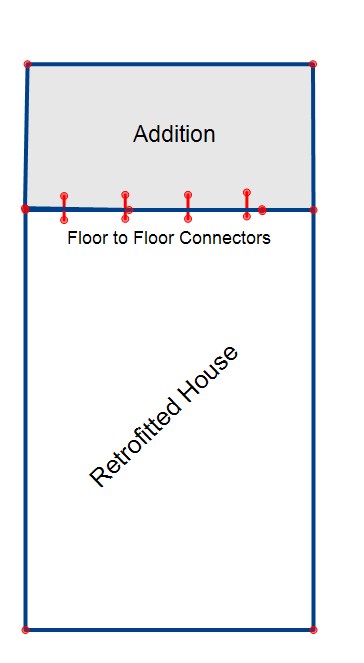
HARDWARE TO PREVENT EARTHQUAKES FROM PUSHING ADDITION AWAY FROM MAIN HOUSE.
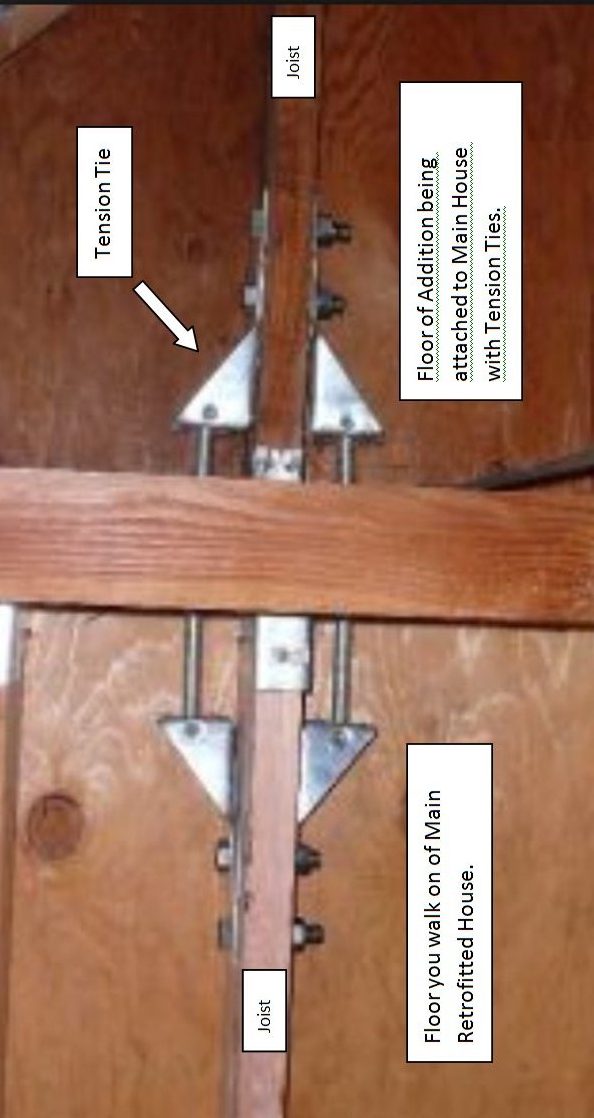
Tension Ties in Retrofitting Room Additions
Separation can also occur when the main addition rotates away from the addition. To the right is one solution using horizontal hold downs.